For this post, I chose to explore experiential learning because it closely matches some of the most effective learning experiences I have had outside the classroom. More than just a preference, it helps explain why certain experiences stayed with me long after formal instruction ended while others quickly faded.
What Experiential Learning Actually Means
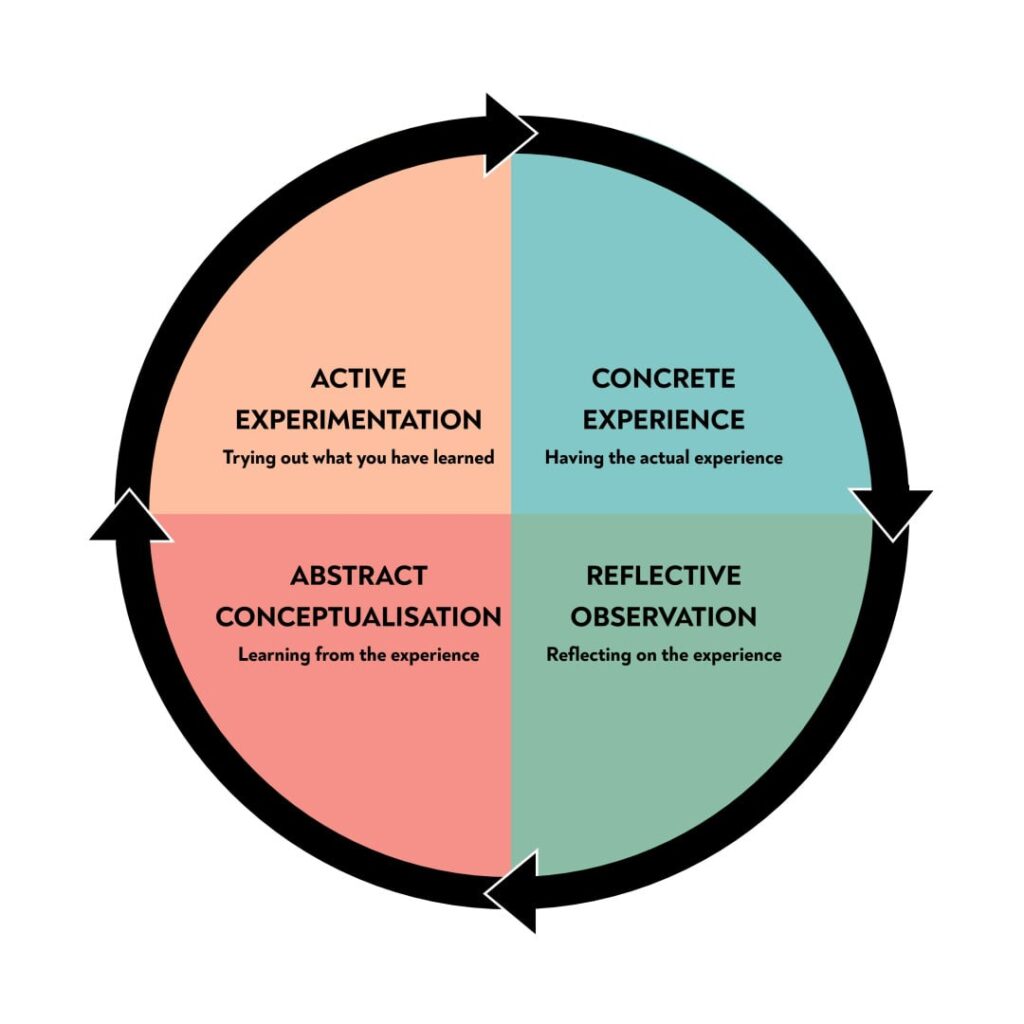
Kolb (1984) described experiential learning as a cycle consisting of concrete experience, reflective observation, abstract conceptualization, and active experimentation. Rather than viewing learning as the passive transfer of information, experiential learning emphasizes that understanding develops through action, reflection, and adaptation. Learners build knowledge by engaging with experiences and refining their mental models over time.
Strength Training as a Learning Environment
One place where I have experienced this cycle firsthand is strength training. Like many beginners, I assumed progress was mostly about finding the perfect workout program. I spent countless hours watching videos, reading articles, and comparing routines. While I accumulated information, I was not developing a deep understanding of how training principles applied to me.
Progress only came when I started treating the gym like an experiment. I tracked workouts, adjusted training volume, modified exercise selection, and observed how my body responded. Some approaches worked well, while others failed completely. Each result became feedback that shaped my understanding of concepts such as progressive overload, recovery, and exercise technique.
Looking back, what I initially viewed as wasted time was actually part of the learning process. The mistakes forced me to question assumptions, reflect on outcomes, and develop a deeper understanding of why certain approaches were effective. This aligns closely with constructivist perspectives that view learners as active participants in constructing knowledge rather than passive recipients of information (Ertmer & Newby, 2018).
A Fair Critique
Experiential learning is not without limitations. Kirschner, Sweller, and Clark (2006) argue that minimally guided learning can be ineffective for novices because they often lack the prior knowledge needed to learn efficiently from experience alone. Reflecting on my own journey, I can see some truth in this argument. A knowledgeable coach could have helped me avoid many mistakes and accelerate my progress.
For this reason, I do not see experiential learning as a replacement for instruction. Instead, I view direct instruction and experiential learning as complementary approaches. Instruction provides the foundation, while experience transforms information into understanding.
Technology as a Feedback Amplifier
Technology can strengthen experiential learning by making feedback more immediate and visible. Fitness tracking applications, wearable devices, and online communities help learners collect data, identify patterns, and reflect on performance. This idea also connects to connectivism, which emphasizes learning through networks of people, resources, and digital tools (Siemens, 2005).
Ultimately, experiential learning resonates with me because it captures how I learn best: through action, reflection, and continuous improvement rather than simply consuming information.
References
Ertmer, P. A., & Newby, T. J. (2018). Behaviorism, cognitivism, constructivism: Comparing critical features from an instructional design perspective. In R. E. West (Ed.), Foundations of learning and instructional design technology. EdTech Books.
Kirschner, P. A., Sweller, J., & Clark, R. E. (2006). Why minimal guidance during instruction does not work: An analysis of the failure of constructivist, discovery, problem-based, experiential, and inquiry-based teaching. Educational Psychologist, 41(2), 75–86.
Kolb, D. A. (1984). Experiential learning: Experience as the source of learning and development. Prentice-Hall.
Siemens, G. (2005). Connectivism: A learning theory for the digital age. International Journal of Instructional Technology and Distance Learning, 2(1), 3–10.

Recent Comments